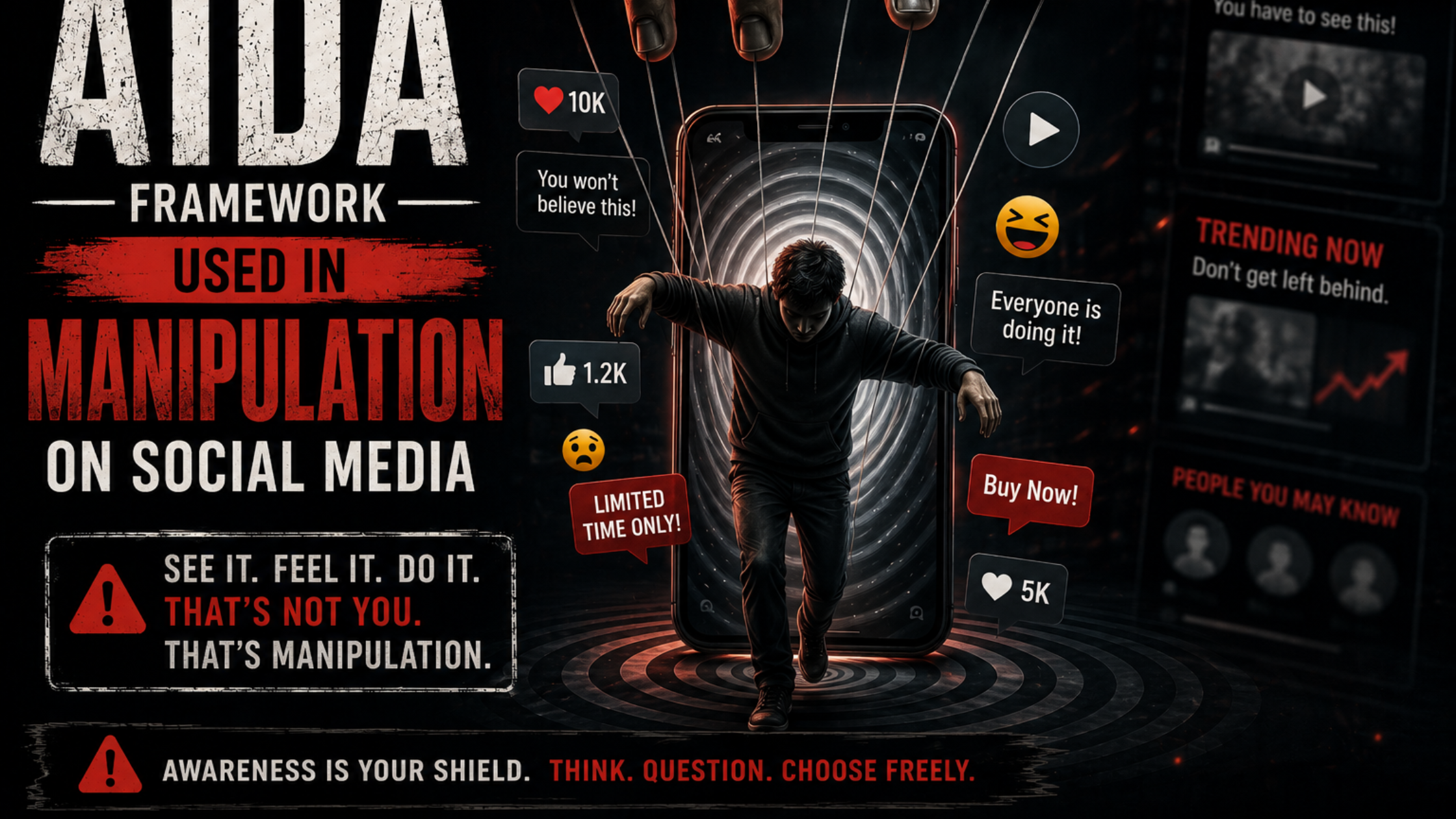
Marketers have used the AIDA framework — Attention, Interest, Desire, Action — for over a century to move people from noticing something to acting on it. It turns out the same four stages make a surprisingly good lens for understanding how misinformation spreads, and how we can teach people to catch themselves before they fall for it.
Every viral hoax, clickbait headline, and manipulative ad follows the same path AIDA describes. If we can teach people to recognize each stage as it’s happening to them, we give them a real-time checkpoint system instead of a vague instruction to “think critically.”
Attention: What Grabbed You, and Why?
The first job of any piece of content — true or false — is to stop your scroll. Bad actors rely on emotionally loaded images, shocking numbers, or headlines that skip the nuance entirely.
Media literacy checkpoint: Before reacting, ask what technique is being used to grab my attention? Is it fear, outrage, humor, or curiosity? Naming the emotional hook doesn’t mean the content is false — but noticing it puts a half-second of distance between the stimulus and your response, which is often all it takes to avoid an impulsive share.
Interest: Who’s Talking, and What’s the Evidence?
Once attention is captured, content builds interest by seeming credible: citing a “study,” using expert-sounding language, or presenting statistics.
Media literacy checkpoint: This is where source-checking belongs. Who published this? What’s their track record? Is the “study” linked, and does it actually say what the headline claims? Teaching people to pause here — before they’re emotionally invested — is far more effective than asking them to fact-check after they already believe something.
Desire: What Does This Make You Want to Believe?
Good persuasion (and good propaganda) creates a desire for the conclusion to be true. It might confirm something you already suspected, flatter your identity, or offer a satisfying villain.
Media literacy checkpoint: Ask would I want this to be true even if it weren’t? This is the hardest stage to interrupt, because it operates on identity and emotion rather than logic. Simply naming confirmation bias out loud — “I want this to be true because it matches what I already think” — is often enough to loosen its grip.
Action: What Are You Being Asked to Do?
The final stage is the call to action: share, comment, donate, vote, buy. This is where misinformation does its real damage, because sharing is what spreads it further.
Media literacy checkpoint: Before acting, ask what happens if I’m wrong? A share takes one second; a retraction rarely reaches the same audience. Building a personal rule — like waiting 24 hours before sharing anything emotionally charged — turns this checkpoint into a habit rather than a one-time decision.
Why the Reversal Works
Teaching AIDA as a marketing tool shows people how they’re being moved. Teaching it as a media literacy tool shows them how to notice the movement while it’s happening. The framework doesn’t change — only the posture does: from persuader to skeptic, and from message to filter.
The four-question version is simple enough to actually use in the moment:
- What’s grabbing my attention, and how?
- Who’s speaking, and what’s their evidence?
- What do I want to be true here?
- What happens if I act on this and I’m wrong?
That’s the whole framework, run in reverse — and it fits in the time it takes to read a headline.



Leave a Reply